

Theo runs a property management software company in Australia. When he decided to add mobile apps to his platform, his initial instinct was native, separate iOS and Android apps built by separate specialists. His CTO talked him out of it, not by showing him a framework comparison chart but by walking him through what the next eighteen months would look like if they went native: two codebases to maintain, two sets of bugs to track, two separate release cycles to coordinate, and two distinct teams whose work had to be synchronized without diverging. For a company his size, that was a coordination overhead he hadn’t fully priced into the decision.
He went cross-platform instead and launched both apps simultaneously six weeks ahead of the original native timeline. The decision didn’t sacrifice quality in any way his property managers or their tenants noticed. It did save his engineering team a significant amount of duplicated work across the following year of iteration. What he found during that process, working with a cross-platform app development company that genuinely understood the trade-offs rather than just advocating for their preferred stack, shaped his view of when cross-platform is clearly the right choice and when it isn’t.
What Cross-Platform Development Actually Means in Practice
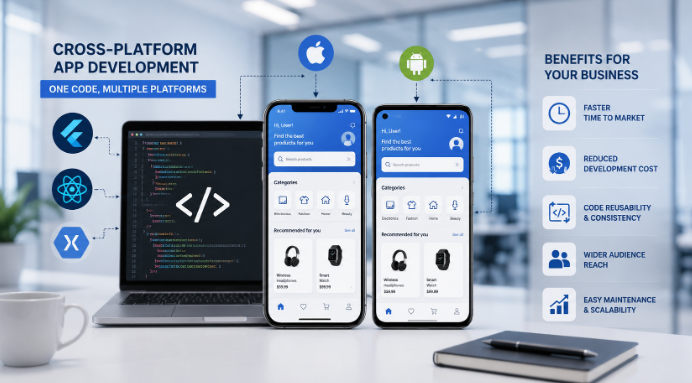
Cross-platform mobile development means building an app from a single shared codebase that deploys to both iOS and Android rather than maintaining separate native codebases in Swift (iOS) and Kotlin (Android). The shared codebase handles the logic, the UI, the API calls, the state management, and most platform-specific integrations, with a thin layer of platform-specific code handling the cases where iOS and Android genuinely behave differently.
For a business, the implications are straightforward. One codebase means one team working in one language on one set of files. A bug fixed in the shared codebase is fixed on both platforms simultaneously. A new feature built once ships to iOS and Android at the same time. Code reviews happen once. Documentation is written once. Onboarding a new developer means getting them up to speed on one codebase rather than two.
The time and cost savings are real and measurable. Development teams consistently report thirty to fifty percent reduction in build time for cross-platform projects compared to equivalent native builds. The maintenance savings compound over the life of the product: every OS update from Apple or Google that requires code changes requires one set of changes rather than two.
Where the Time Savings Actually Come From
The most significant time savings in cross-platform development aren’t in initial feature development, though those are real. They’re in the ongoing maintenance work that never shows up in an initial project estimate but constitutes a significant portion of the total engineering time a product consumes over its lifetime.
Platform OS updates are the clearest example. Apple releases a major iOS version every September. Google releases major Android updates on a similar cadence. Each update introduces new APIs, deprecates old ones, and occasionally changes behavior in ways that break existing apps. In a native setup, these updates require parallel remediation work across two codebases by two teams with different schedules. In a cross-platform setup, most remediation work touches the shared codebase once.
Regulatory compliance updates in industries like healthcare, finance, and legal technology require code changes to maintain compliance with new requirements. In cross-platform development, those changes are made once and deployed to both platforms.
Third-party library updates, security patches, and dependency maintenance all follow the same pattern: work done once in a shared codebase rather than twice across parallel codebases.
The Framework Landscape and How to Choose
Top 5 cross-platform frameworks for mobile app development each take a different technical approach to the problem, and understanding what separates them helps explain why different projects land on different choices.
Flutter, developed by Google and using the Dart language, has its own rendering engine (Skia, with Impeller on newer devices) that draws UI components directly rather than mapping to native platform widgets. This produces pixel-perfect consistency across platforms and strong animation performance. Flutter has the largest and fastest-growing developer community among cross-platform frameworks and is the default choice for most new cross-platform projects in 2026.
React Native, developed by Meta, uses JavaScript or TypeScript and maps UI components to native platform widgets rather than rendering its own. This produces a more “native feel” on each platform at the cost of occasional platform-specific inconsistencies. React Native has a mature ecosystem and a large developer community, and its JavaScript foundation makes it accessible to teams with web development backgrounds.
Kotlin Multiplatform, from JetBrains, shares business logic and data layers across platforms while leaving UI entirely native on each platform. This produces the best native feel and the deepest platform integration of any cross-platform approach, at the cost of more total code than other frameworks. It’s the right choice for projects where native UI fidelity is genuinely critical and the team has strong Kotlin expertise.
Xamarin, from Microsoft (now largely superseded by .NET MAUI), uses C# and targets teams already invested in the Microsoft ecosystem. Its community has declined as Flutter and React Native have grown, making it a less common choice for new projects.
Ionic, a web-based hybrid framework using standard web technologies wrapped in a native container, remains relevant for projects where web development teams need mobile presence quickly and where the performance characteristics of a web-based experience are acceptable for the use case.
Where Cross-Platform Doesn’t Save Resources
Honest advocacy for cross-platform development includes acknowledging where native development is genuinely better, not just differently branded.
Applications with heavy platform-specific hardware integration, using iOS-specific capabilities like Apple Watch complication development, deep HealthKit integration with watchOS, or ARKit features that don’t have Android equivalents, sometimes require native development for the platform where those capabilities live. Building those features through cross-platform frameworks is possible but occasionally produces more complexity than a native implementation would.
Performance-intensive applications, primarily games and applications with complex real-time 3D rendering, typically achieve better results with native development or game engine frameworks like Unity that are purpose-built for the performance requirements involved.
Applications where the user experience is specifically designed around one platform’s native conventions and should feel identical to a first-party platform app are sometimes better served by native development, though this case is rarer than it’s often claimed to be.
The Business Case Beyond the Technical Comparison
For most businesses evaluating cross-platform development, the decision framework isn’t purely technical. It’s organizational.
A company with a team of JavaScript developers building a mobile companion to their web product will move significantly faster and maintain more coherent code ownership in React Native than hiring a separate native iOS and Android team whose work diverges from the web platform’s architecture. The organizational efficiency is as important as the technical efficiency.
A startup with limited budget building an MVP to validate product-market fit should almost never choose native development for the initial version. The timeline advantage of cross-platform, thirty to fifty percent faster, directly affects how quickly validation can happen and how many iteration cycles fit within the available runway.
A company planning to expand to web, desktop, or embedded platforms beyond mobile should evaluate Flutter specifically, given its ability to target iOS, Android, web, macOS, Windows, and Linux from a single codebase, reducing future expansion to an incremental investment rather than a full platform rebuild.
What Theo’s Decision Looked Like a Year Later
Twelve months after launch, his property management mobile apps had gone through three significant feature releases and two major OS compatibility updates. His development team described the cross-platform setup as feeling like maintaining one product rather than two, which is precisely what it was.
The one area where cross-platform created additional work rather than saving it was a specific integration with iOS’s local notification system that behaved differently from the Android equivalent in ways the shared codebase couldn’t fully abstract. That integration required three additional days of platform-specific code. Set against the months of parallel maintenance work the cross-platform choice had avoided, it was not a decision he questioned.
He describes the most useful reframe from that experience as thinking about cross-platform versus native as an organizational decision with technical implications rather than a technical decision with organizational consequences. For his company’s structure, team composition, and product roadmap, cross-platform was clearly right. The savings were real, not hypothetical, and they continued to accumulate month by month rather than showing up only at the point of the initial build.